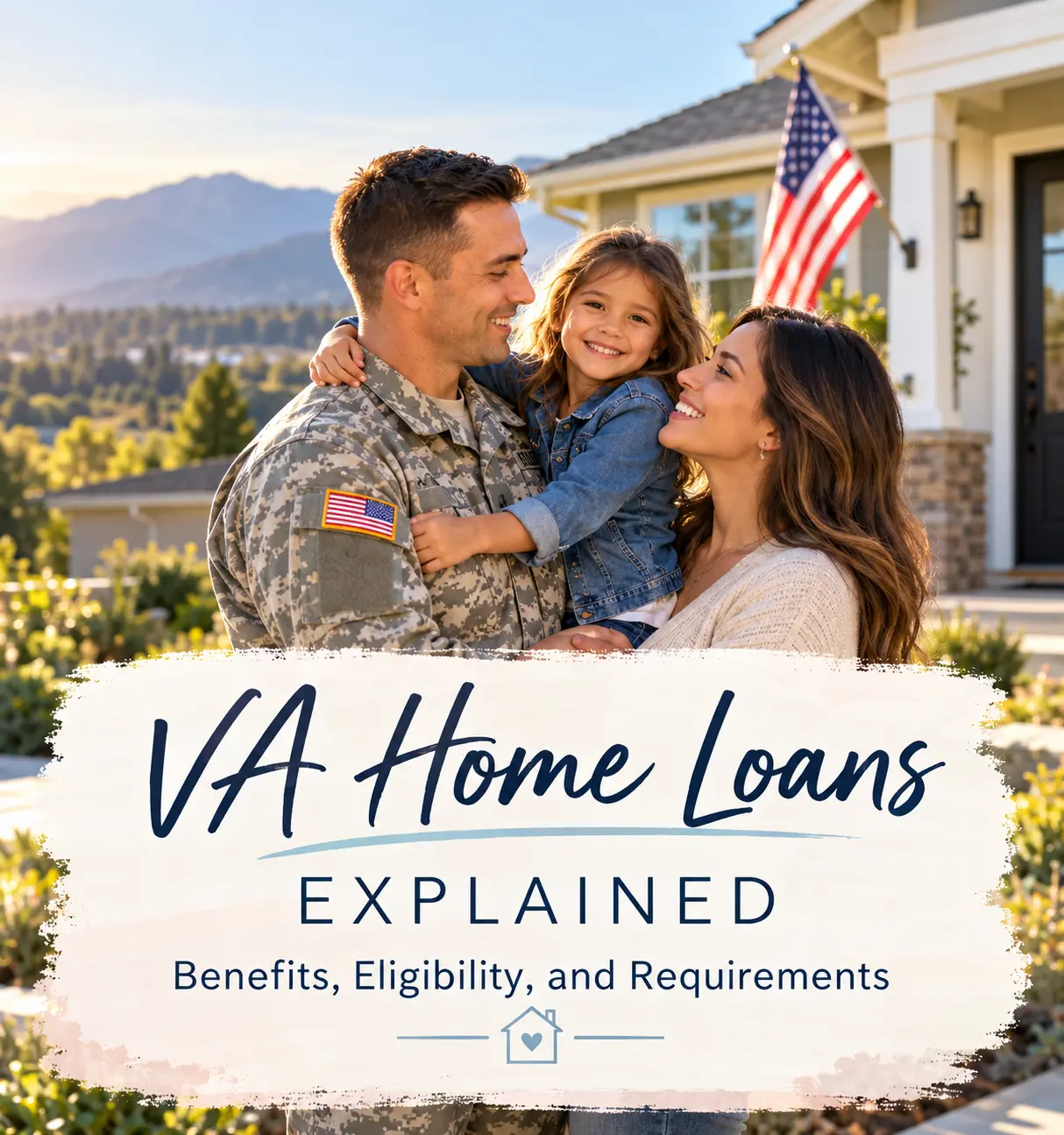
If you've served our country, you deserve to understand the homeownership benefits you've earned. And one of the most valuable benefits available to eligible veterans and military families is the VA home loan.
Whether you're buying your first home, moving back to Northern California, or looking for a home that better fits your family's needs, VA financing can make homeownership more accessible than you might realize.
As a local mortgage advisor serving Redding, Shasta County, Red Bluff, Chico, and surrounding Northern California communities, I love helping veterans and military families understand their options and make the most of their VA home loan benefits.
Let's walk through how VA loans work, what makes them special, and what you need to know before getting started.
A VA home loan is a mortgage backed by the U.S. Department of Veterans Affairs. The program helps eligible veterans, active-duty service members, and certain surviving spouses purchase homes with favorable financing options.
One important thing to understand is that the VA doesn't typically lend you the money directly. Instead, private mortgage lenders provide the financing, and the VA guarantees a portion of the loan.
That government backing helps make some pretty wonderful benefits possible, including no down payment for many eligible borrowers and no monthly mortgage insurance.
VA loans can be used to purchase several types of eligible properties, including single-family homes, certain condominiums, manufactured homes, and properties with up to four units.
The home must generally be your primary residence, and the property must meet applicable VA requirements.
For veterans hoping to put down roots in Redding or the surrounding communities, this program can open doors that might otherwise feel out of reach.
There are plenty of reasons I encourage eligible veterans to explore their VA financing options. Here are five of the biggest advantages.
This is one of my favorite VA loan benefits to explain!
Many eligible VA borrowers can purchase a home with 0% down, meaning they may not need to save tens of thousands of dollars for a down payment before becoming homeowners.
Let's say you're purchasing a $400,000 home in the Redding area.
With a 5% down payment, you'd need $20,000 just for the down payment itself. But with an eligible VA loan, you may be able to finance the entire purchase price, subject to the property's appraised value and lender approval.
That means more of your savings could stay in your pocket for moving expenses, furnishings, home improvements, or simply having a financial cushion.
Of course, zero down payment doesn't necessarily mean zero closing costs. There may still be expenses associated with purchasing your home, which we'll discuss below.
Here's another benefit that can make a real difference in your monthly budget.
With many conventional mortgages, borrowers who put less than 20% down are required to pay private mortgage insurance, commonly called PMI.
VA loans don't require monthly mortgage insurance.
That means eligible veterans may be able to purchase a home with no down payment while avoiding the additional monthly mortgage insurance expense that often comes with other financing options.
Over time, those potential savings can really add up!
Because VA loans are partially guaranteed by the federal government, lenders can often offer competitive interest rates.
Your actual rate will depend on several factors, including your credit history, loan terms, current market conditions, and lender pricing.
Even a small difference in your interest rate can affect your monthly mortgage payment and how much interest you pay over the life of your loan.
When we review your mortgage options together, I can help you understand how different loan terms and payment scenarios may fit your financial goals.
If your credit isn't perfect, please don't assume homeownership is out of the question.
The Department of Veterans Affairs doesn't establish a universal minimum credit score for VA loans.
However, individual mortgage lenders may have their own minimum credit score requirements and underwriting guidelines.
Your lender will also review your payment history, income, existing debts, and overall financial circumstances.
I've always believed that understanding your options is better than assuming you don't qualify. Even if you're not quite ready to purchase today, reviewing your financial picture can help you identify your next steps.
This one surprises a lot of people!
Your VA home loan benefit isn't necessarily something you use once and lose forever.
Eligible veterans may be able to use their VA financing benefits multiple times throughout their lives.
For example, if you purchased a home with a VA loan and later sold it, you may be able to restore your entitlement and use a VA loan again to purchase another primary residence.
In some situations, borrowers may even qualify to have more than one VA loan at the same time.
The details depend on your available entitlement and individual circumstances, but it's absolutely worth exploring if you've used your VA benefit before.
VA home loan eligibility is based primarily on your military service history, duty status, and certain other qualifying circumstances.
You may be eligible if you're:
A veteran who meets applicable service requirements
An active-duty service member with sufficient qualifying service
A qualifying member of the National Guard or Reserves
An eligible surviving spouse of a deceased service member or veteran
The exact service requirements depend on when and how you served.
For example, many active-duty service members become eligible after 90 continuous days of qualifying service. Veterans who served during different periods may have different requirements.
Certain exceptions may also apply to individuals who don't meet the standard minimum service requirements.
Before using your VA home loan benefit, you'll need a Certificate of Eligibility (COE).
Your COE confirms that you meet the military service requirements for the VA home loan program.
You can request one directly through the Department of Veterans Affairs, or a participating mortgage lender (such as myself) can often help obtain it for you.
And don't worry if you don't already have yours! It's something I can help you navigate as we explore your financing options.
Just remember that a COE confirms your eligibility for the benefit. You'll still need to meet the lender's credit, income, and underwriting requirements to receive mortgage approval.
Although VA loans offer some fantastic advantages, they're still mortgages, which means lenders need to verify that borrowers can comfortably manage their financial obligations.
Here's what that generally involves.
When applying for a VA mortgage, your lender will evaluate your credit history, employment, income, and existing debts.
VA underwriting also places particular importance on something called residual income.
Residual income is the money you have remaining each month after accounting for major financial obligations, including housing expenses, debts, and certain other costs.
The idea is to help determine whether you'll have sufficient money left over for everyday living expenses after making your mortgage payment.
It's an important part of evaluating your overall financial picture.
Most VA borrowers are required to pay a one-time VA funding fee.
This fee helps support the VA home loan program and reduce its cost to taxpayers.
The amount varies depending on factors such as whether you've used your VA benefit before and whether you're making a down payment.
However, certain borrowers are exempt from the funding fee, including many veterans receiving VA disability compensation for service-connected disabilities.
If you're required to pay the fee, it can generally be financed into your mortgage rather than paid entirely out of pocket at closing.
Understanding whether you qualify for an exemption is one of the details worth reviewing before moving forward.
Yes, you may still have closing costs even if you're purchasing with no down payment.
These expenses can include appraisal fees, title and escrow charges, prepaid property taxes, homeowners insurance, and other costs associated with your transaction.
Depending on the circumstances, sellers may be able to contribute toward allowable closing costs.
When we're reviewing your financing options, I can help you understand your estimated cash needed to close so you know what to expect before making an offer.
If you're thinking about purchasing a home in Redding, Anderson, Red Bluff, Chico, or another Northern California community, here's what the VA homebuying process typically looks like.
Step 1: Verify Your VA Home Loan Eligibility
We'll start by confirming your eligibility and reviewing your Certificate of Eligibility. This is also a good opportunity to discuss whether you've previously used your VA benefits and how much entitlement you have available.
Step 2: Get Pre-Approved for Your Mortgage
Next, we'll review your income, credit, assets, and financial obligations to determine a potential purchase price and loan amount.
I also like to spend time discussing your estimated monthly payment and overall comfort level. Just because you qualify for a certain amount doesn't necessarily mean you need to spend that much!
Step 3: Start Shopping for Your Home
Once you're pre-approved, you can begin looking for the right property.
Whether that's a home near the Sacramento River in Redding, a little more space in Anderson, or a property in Red Bluff or Chico, working with a real estate agent who understands VA financing can be incredibly helpful.
Step 4: Complete the Appraisal and Loan Approval Process
After your offer is accepted, your mortgage moves through processing and underwriting.
A VA appraisal will also be ordered to evaluate the property's value and determine whether it meets the VA's Minimum Property Requirements.
Keep in mind that a VA appraisal isn't the same as a comprehensive home inspection. Buyers should consider obtaining a separate home inspection to better understand the property's condition.
Step 5: Close on Your New Home!
Once all applicable loan conditions have been satisfied, you'll complete your closing documents and prepare to receive the keys to your new home.
There's something special about helping a family reach that moment, especially when it's made possible through a benefit earned through military service.
The Department of Veterans Affairs doesn't establish a universal minimum credit score for VA home loans. However, individual lenders may have their own credit requirements. Your credit history, income, debts, and overall financial situation will all play a role in determining whether you qualify.
Yes! Many eligible veterans with sufficient VA entitlement can purchase a home with no down payment, subject to the property's appraised value and lender approval. However, you may still be responsible for closing costs and prepaid expenses, depending on your transaction.
Absolutely! Eligible veterans may be able to use their VA loan benefits multiple times. In many cases, entitlement can be restored after a previous VA-financed property is sold and the loan is paid off. Some borrowers may also qualify to use remaining entitlement while keeping an existing VA loan.
For borrowers with full VA entitlement, the Department of Veterans Affairs generally doesn't impose a county-based loan limit. However, that doesn't mean you can borrow an unlimited amount. Your lender must still approve the loan based on your income, credit, financial qualifications, and the property's value. Borrowers with partial entitlement may be subject to additional considerations involving county loan limits and down payment requirements.
Yes! Eligible borrowers can use VA home loans to purchase qualifying properties throughout Redding, Shasta County, Red Bluff, Chico, and other Northern California communities. The home must meet applicable VA property requirements and generally be used as your primary residence.
If you've earned VA home loan benefits through your military service, I want you to feel confident understanding how they work and what opportunities may be available to you.
From purchasing with no down payment to avoiding monthly mortgage insurance, VA financing offers advantages that can make a meaningful difference when buying a home.
And whether you're ready to start house hunting tomorrow or you're simply exploring your options for the future, you don't have to figure everything out on your own.
Thinking about buying a home with your VA benefits?
I'd love to help you explore your options, answer your questions, and create a plan that fits your goals.
Contact Cindy Tomlinson today to get started with your VA home loan journey!
All loans are subject to credit approval, underwriting guidelines, and applicable VA requirements. Loan terms and program availability may vary.